|
|
|
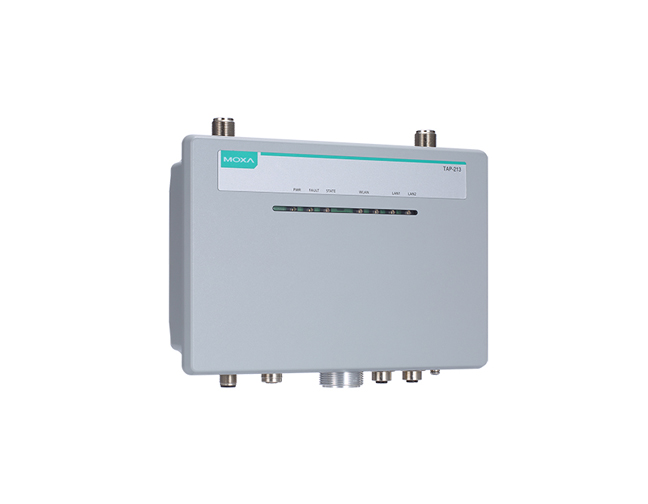
Moxa TAP-213-US-CT-T - 802.11n Railway Onboard Out-door Single Radio Access Point/Client, M12, US band, IP68, -40 to 75C
by MOXA
|
|
|
|
- IEEE 802.11a/b/g/n compliant
- Can be powered by redundant dual DC power inputs or PoE
- QoS (WMM) and VLAN for efficient network traffic
- Controller-based Turbo Roaming
- Complies with all EN 50155 mandatory test items*
- Rugged IP68-rated housing and -40 to 75°C operating temperature
- Wireless network redundancy with AeroLink protection
*This product is suitable for rolling stock railway applications, as defined by the
EN 50155 standard.
|
|
|
The TAP-213, TAP-213-US-CT-T, outdoor wireless AP/client is the ideal ruggedized wireless solution for railway onboard train-to-ground applications such as CCTV and CBTC communications. The TAP-213’s dust-tight, weatherproof design is IP68-rated, allowing you to extend wireless networks to outdoor locations and critical environments. The two redundant DC power inputs increase the reliability of the power supply and the device can also be powered via PoE for easier deployment. The TAP-213 is compliant with industrial standards and railway approvals covering operating temperature, power input voltage, surge, ESD, and
vibration. With many hardened industrial-grade features, the TAP-213 will provide stable and reliable wireless connectivity, especially for railway onboard environments.
Features for Critical Environments
- IP68-rated metal housing and -40 to 75°C wide operating temperature
- Anti-vibration M12 design and waterproof/dust-tight connectors
- PoE and dual DC power inputs
Specifications for Railway Applications
- High power 400 mW (max.) radio
- Wide range power input from 24 to 110 VDC
- Client-based Turbo Roaming handover time less than 150 ms with 1 channel and WPA2, and less than 350 ms with 3 channels and WPA2
- Controller-based Turbo Roaming handover time (available only when used with the WAC-1001 or WAC-2004) less than 50 ms with 3 channels and WPA2
- Multiple roaming parameters for different installation structures and antenna types
| • WLAN Interface |
| Standards |
IEEE 802.11a/b/g/n for Wireless LAN
IEEE 802.11i for Wireless Security
IEEE 802.3 for 10BaseT
IEEE 802.3u for 100BaseT(X)
IEEE 802.3ab for 1000BaseT
IEEE 802.3af for Power-over-Ethernet
IEEE 802.1D for Spanning Tree Protocol
IEEE 802.1w for Rapid STP
IEEE 802.1p for Class of Service
IEEE 802.1Q for VLAN |
| Spread Spectrum and Modulation (typical) |
• DSSS with DBPSK, DQPSK, CCK
• OFDM with BPSK, QPSK, 16QAM, 64QAM
• 802.11b: CCK @ 11/5.5 Mbps, DQPSK @ 2 Mbps, DBPSK @ 1 Mbps
• 802.11a/g: 64QAM @ 54/48 Mbps, 16QAM @ 36/24 Mbps, QPSK @ 18/12 Mbps, BPSK @ 9/6 Mbps
• 802.11n: 64QAM @ 300 Mbps to BPSK @ 6.5 Mbps (multiple rates supported) |
| Operating Channels (central frequency) |
• US:
2.412 to 2.462 GHz (11 channels)
5.180 to 5.240 GHz (4 channels)
5.260 to 5.320 GHz (4 channels)*
5.500 to 5.700 GHz (8 channels; excludes 5.600 to 5.640 GHz)*
5.745 to 5.825 GHz (5 channels)
• EU:
2.412 to 2.472 GHz (13 channels)
5.180 to 5.240 GHz (4 channels)
5.260 to 5.320 GHz (4 channels)*
5.500 to 5.700 GHz (11 channels)*
• JP:
2.412 to 2.484 GHz (14 channels, DSSS)
5.180 to 5.240 GHz (4 channels)
5.260 to 5.320 GHz (4 channels)*
5.500 to 5.700 GHz (11 channels)* |
| • *Special frequency bands (up to 6.0 GHz) are available for customization. |
| Security |
• SSID broadcast enable/disable
• Firewall for MAC/IP/Protocol/Port-based filtering
• 64-bit and 128-bit WEP encryption, WPA /WPA2 Personal and Enterprise (IEEE 802.1X/RADIUS, TKIP and AES) |
| Transmission Rates |
• 802.11b: 1, 2, 5.5, 11 Mbps
• 802.11a/g: 6, 9, 12, 18, 24, 36, 48, 54 Mbps
• 802.11n: 6.5 to 300 Mbps (multiple rates supported) |
| Transmitter Power |
802.11b:
• Typ. 26±1.5 dBm @ 1 Mbps
• Typ. 26±1.5 dBm @ 2 Mbps
• Typ. 26±1.5 dBm @ 5.5 Mbps
• Typ. 25±1.5 dBm @ 11 Mbps
802.11g:
• Typ. 23±1.5 dBm @ 6 to 24 Mbps
• Typ. 21±1.5 dBm @ 36 Mbps
• Typ. 19±1.5 dBm @ 48 Mbps
• Typ. 18±1.5 dBm @ 54 Mbps
802.11n (2.4 GHz):
• Typ. 23±1.5 dBm @ MCS0/8 20 MHz
• Typ. 18±1.5 dBm @ MCS7/15 20 MHz
• Typ. 23±1.5 dBm @ MCS0/8 40 MHz
• Typ. 17±1.5 dBm @ MCS7/15 40 MHz
802.11a:
• Typ. 23±1.5 dBm @ 6 to 24 Mbps
• Typ. 21±1.5 dBm @ 36 Mbps
• Typ. 20±1.5 dBm @ 48 Mbps
• Typ. 18±1.5 dBm @ 54 Mbps
802.11n (5 GHz):
• Typ. 23±1.5 dBm @ MCS0/8 20 MHz
• Typ. 18±1.5 dBm @ MCS7/15 20 MHz
• Typ. 23±1.5 dBm @ MCS0/8 40 MHz
• Typ. 18±1.5 dBm @ MCS7/15 40 MHz |
| Receiver Sensitivity |
802.11b:
• -93 dBm @ 1 Mbps
• -93 dBm @ 2 Mbps
• -93 dBm @ 5.5 Mbps
• -88 dBm @ 11 Mbps
802.11g:
• -88 dBm @ 6 Mbps
• -86 dBm @ 9 Mbps
• -85 dBm @ 12 Mbps
• -85 dBm @ 18 Mbps
• -85 dBm @ 24 Mbps
• -82 dBm @ 36 Mbps
• -78 dBm @ 48 Mbps
• -74 dBm @ 54 Mbps
802.11n (2.4 GHz):
• -70 dBm @ MCS7 20 MHz
• -69 dBm @ MCS15 20 MHz
• -67 dBm @ MCS7 40 MHz
• -67 dBm @ MCS15 40 MHz
802.11a:
• -90 dBm @ 6 Mbps
• -88 dBm @ 9 Mbps
• -88 dBm @ 12 Mbps
• -85 dBm @ 18 Mbps
• -81 dBm @ 24 Mbps
• -78 dBm @ 36 Mbps
• -74 dBm @ 48 Mbps
• -74 dBm @ 54 Mbps
802.11n (5 GHz):
• -69 dBm @ MCS7 20 MHz
• -71 dBm @ MCS15 20 MHz
• -63 dBm @ MCS7 40 MHz
• -68 dBm @ MCS15 40 MHz |
| • Protocol Support |
| General Protocols |
Proxy ARP, DNS, HTTP, HTTPS, IP, ICMP, SNTP, TCP, UDP, RADIUS, SNMP, PPPoE, DHCP |
| AP-only Protocols |
ARP, BOOTP, DHCP, STP/RSTP (IEEE 802.1D/w) |
| • Interface |
| LAN Ports |
1, M12 X-coded 8-pin female connector, 10/100/1000BaseT(X) auto negotiation speed, F/H duplex mode, and auto MDI/MDI-X connection |
| Console Port |
M12 B-coded 5-pin female connector for the USB console |
| USB Port |
M12 A-coded 5-pin female connector for ABC-02 USB storage |
| Reset |
Present |
| LED Indicators |
PWR, FAULT, STATE, WLAN, LAN 1, LAN 2 |
| Fiber Port |
100/1000Base SFP slot |
| Connector for External Antennas |
N-type (female) |
| • Physical Characteristics |
| Housing |
Metal, IP68 protection |
| Weight |
1500 g (3.31 lb) |
| Dimensions |
220 x 150 x 50.5 mm (8.66 x 5.90 x 1.99 in) |
| Installation |
Wall mounting (standard), DIN-rail mounting (optional), pole mounting (optional) |
| • Environmental Limits |
| Operating Temperature |
-40 to 75°C (-40 to 167°F) |
| Storage Temperature |
-40 to 85°C (-40 to 185°F) |
| Ambient Relative Humidity |
5% to 95% (non-condensing) |
| • Power Requirements |
| Input Voltage |
24 to 110 VDC, redundant dual DC power inputs or 48 VDC Power-over-Ethernet (IEEE 802.3af compliant) |
| Input Current |
0.65 A @ 24 VDC, 0.16 A @ 110 VDC |
| Connector |
M12 A-coded 4-pin male connector |
| Power Consumption |
17.6 W (max.) |
| Reverse Polarity Protection |
Present |
| • Standards and Certifications |
| Safety |
UL 60950-1, IEC 60950-1(CB), LVD EN 60950-1 |
| EMC |
EN 61000-6-2/6-4 |
| EMI |
CISPR 22, FCC Part 15B Class A |
| EMS |
IEC 61000-4-2 ESD: Contact: 6 kV; Air: 8 kV
IEC 61000-4-3 RS: 80 MHz to 1 GHz: 20 V/m
IEC 61000-4-4 EFT: Power: 2 kV; Signal: 2 kV
IEC 61000-4-5 Surge: Power: 2 kV; Signal: 2 kV
IEC 61000-4-6 CS: 10 V
IEC 61000-4-8 |
| Radio |
EN 301 489-1/17, EN 300 328, EN 301 893, TELEC, DFS, FCC ID SLE-WAPN008 |
| Rail Traffic |
EN 50155*, EN 50121-4 |
| Fire and Smoke |
EN 45545-2 |
| *This product is suitable for rolling stock railway applications, as defined by theEN 50155 standard. For a more detailed statement, click here |
www.moxa.com/doc/specs/EN_50155_Compliance.pdf |
| • MTBF (mean time between failures) |
| Time |
758,369 hrs |
| Standard |
Telcordia SR332 |
|
|
|
|